When the Victim Speaks
- Published on
- Nripesh Pradhan--5 min read
When the Crowd Lost Its Innocence: The Bible as Anti-Myth
“Myth tells the story of the killers;
the Gospels let the dead man talk.” — René Girard

0.Quick Recap: The Mythic Pattern
Recall the recurring pattern that governs mythology; Girard calls this four-step loop the 'scapegoat mechanism'.
- Mimetic Desire: Our desires mirror each other, inevitably breeding rivalry.
- Social Crisis: Rivalry intensifies, fracturing the bonds of community.
- Scapegoating: Unity is restored by blaming, expelling, or sacrificing one individual.
- Myth-making: A narrative emerges to justify the violence, silencing the victim.
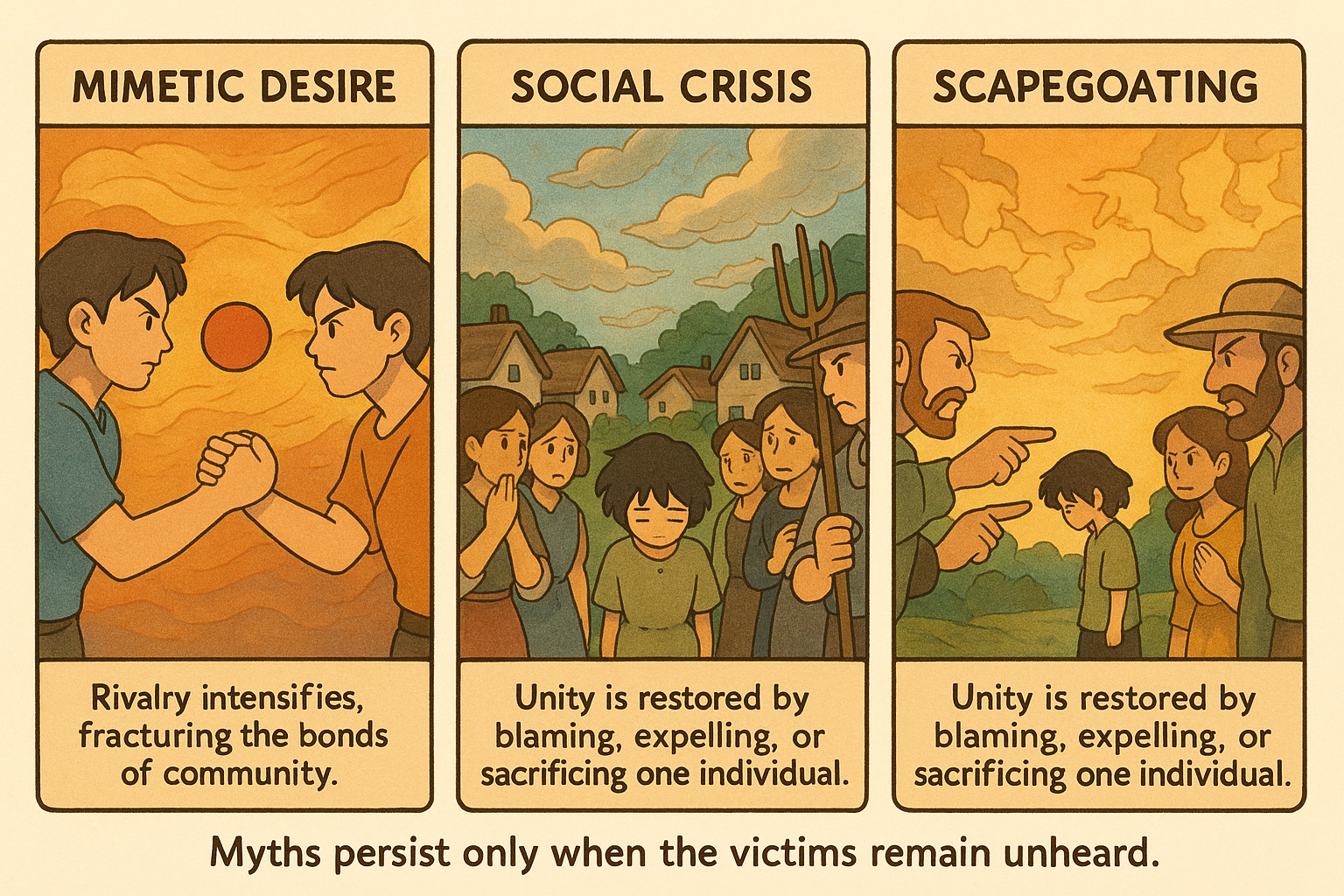
1. The Biblical Shift: When the Victim Speaks
Myths mask violence with neat justifications; the Bible disrupts this comfort by giving voice to the victims. These biblical accounts refuse myth’s comforting silence, forcing us to confront our complicity.
| Mythic Comfort | Biblical Interruption |
| Oedipus (Sophocles): "Banish the guilty king — the plague will end." | Abel (Genesis 4:10): "Your brother’s blood cries out to me from the ground." |
| Romulus & Remus (Livy): Founding murder sacralized: fratricide becomes Rome’s destiny. | Joseph (Genesis 50:20): "You meant evil against me, but God meant it for good." |
| Iphigenia (Euripides): Sacrifice the innocent girl — guarantee victory for the fleet. | Isaac (Genesis 22:12): "Do not lay a hand on the boy." The sacrifice is refused. |
| Aztec Ritual (Codices): Rip out human hearts — the sun demands nourishment. | Christ (Luke 23:34): "Father, forgive them; they know not what they do." |
| Pharmakos (Athens): Expel the scapegoat — blame cleanses the city. | Susanna (Daniel 13:45): "God stirred up the spirit of a young boy named Daniel." |
2. Golgotha: The Crime Myth Couldn't Cover
Jerusalem, Passover week. Jesus, a popular healer and teacher, becomes a threat to the religious and political authorities. Betrayed by one of his followers, he is arrested secretly at night. Religious leaders, avoiding direct blame, hand him over to the Roman governor Pilate.
Pilate orders a brutal public execution. Authorities deflect blame; the crowd demands blood—exactly the old sequence. Jesus is mocked, whipped, and led to Golgotha—a hill used for executing criminals and outcasts. Soldiers drive nails through his hands and feet, gamble for his clothes, and mockingly label him "King of the Jews."
Instead of anger or vengeance, Jesus responds with forgiveness.
This scene exposes violence for what it truly is—unjust and meaningless. After Golgotha, every act of violence, every scapegoating becomes questionable. But this truth is uncomfortable, and so we often drift back into old myths
3. Aftershocks: Modern Shortcuts Back to Violence
Despite the Gospel revelation, the old patterns refuse to die. Scapegoating is hardwired into human nature—an ancient instinct, older than laws, older than reason. When crisis strikes, when fear spreads, we reach for the same tool: blame someone else, cast them out, call it salvation. Letting go of this reflex is not simply a moral project; it is a slow, unnatural struggle against the deep currents of our own history.
We like to imagine we have moved beyond the rituals of blood and blame. In truth, we have merely found new ways to perform them.
3.1 Neo-Pagan Reboots
When societies falter, they turn nostalgically towards ancient rituals of unity and purity. Flags, symbols, and chants resurrect forgotten gods and blood rites, harnessing mythic unity against perceived threats. Nazi pageantry and modern nationalist rhetoric share the same choreography: fuse many voices into one, and then find a victim. History repeats itself not as farce, but as deliberate oblivion.
3.2 Prestige Victimhood
In modern societies, victimhood has become currency—prestigious and politically potent. Movements race to monopolize the moral high ground, weaponizing suffering to silence opposition. The genuine anguish of true victims is blurred by those who wear victimhood as a costume. Social media amplifies the spectacle, drowning out reasoned dialogue, enabling a new violence—more subtle, equally destructive.
3.3 Technocratic Purges
Today’s bureaucracies cloak violence behind a facade of neutrality and objectivity. Algorithms quietly flag human lives as anomalies, turning morality into statistical convenience. Compliance officers and drones both act silently, removing individuals deemed risky or inconvenient. The victim becomes invisible behind sanitized dashboards; injustice continues, neatly rationalized and digitally administered.
These shortcuts promise progress but merely repackage ancient violence in contemporary garb.
4. Resisting the Pull of the Crowd
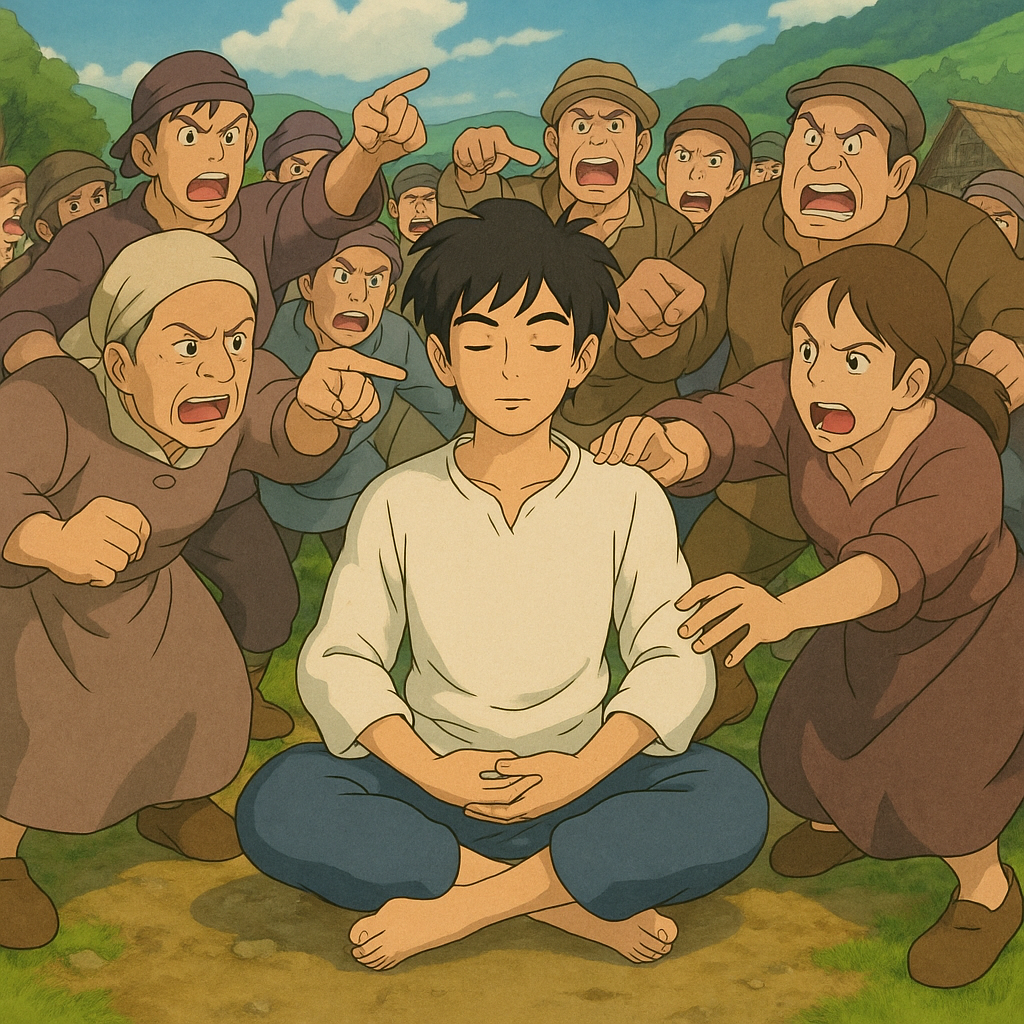
No one is beyond the fold of mimetic desire. It is not a weakness of character but a fundamental condition of being human, as real and constant as gravity. To imagine oneself above it is to risk falling deeper into it.
The true antidote is not to deny mimetic pull, but to stay vigilant — to give Satan his due, recognizing the force of mimesis without being entranced by it.
- Distrust neat narratives: If one person’s removal seems to solve everything, be suspicious.
- Challenge unanimity: Collective applause often hides complicity; true insight is often lonely.
- Evaluate collateral damage: Genuine justice threatens powerful interests, not only vulnerable targets.
- Pause before reacting: Emotional contagion fades; immediate outrage rarely yields thoughtful justice.
- Empathy for adversaries: Defend due process precisely for those you dislike, disrupting scapegoating from within.