The Operating System Beneath Our Arguments
- Published on
- Nripesh Pradhan--5 min read
On Mimetic Desire, Scapegoats, and the Violence We Pretend Is Order
“Man is the creature who does not know what to desire, and he turns to others in order to make up his mind.”
—René Girard
0. Why Bother?
Why have sacrifice and sacred violence appeared in almost every civilization, from ancient Athens to Aztec Tenochtitlan? Are these just historical quirks—or signs of something deeper?
René Girard argued they are not quirks at all. They are artifacts of a universal human mechanism—mimetic desire—that drives conflict, escalates rivalry, and demands resolution through the scapegoat. Religion, myth, and ritual emerged not to explain the stars, but to manage the fallout of human imitation gone rogue.
1. Mimetic Desire: The Forgotten First Principle

Classical economics says we want things because they are useful; marketing says because they are sexy. Girard says we want them because somebody else already wants them. Value is downstream of rivalry. Watch toddlers: one ignores the stuffed giraffe until her cousin grabs it, at which point it becomes the only giraffe in the universe worth screaming about. We never grow out of that mechanism—only into subtler camouflage.
In formal terms:
- Model – a person close enough to imitate but far enough to remain an “other.”
- Appropriation – you desire the thing because the model does.
- Conflict – you can’t both possess it.
- Escalation – every move becomes a signal of status; the object recedes, the rivalry intensifies.
The system is self-amplifying. If all rivals accelerate simultaneously, society tilts toward collapse. There must be a circuit-breaker.
2. The Scapegoat Circuit-Breaker
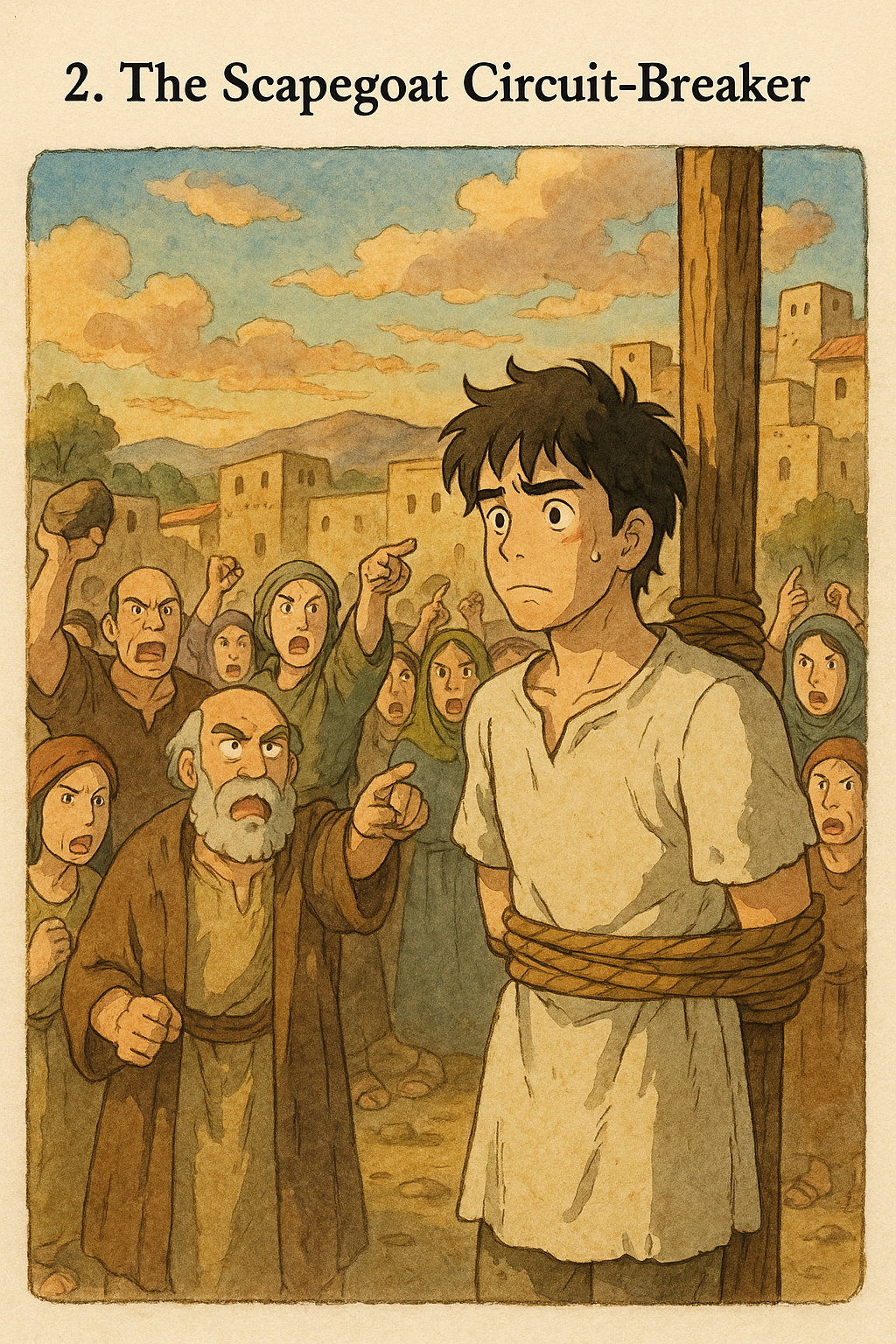
Expulsion masquerading as justice, order built on ritual silence
Enter the scapegoat mechanism—evolution’s brutal patch to keep the tribe from tearing itself apart. The logic is disarmingly simple:
Identify a single target whose removal promises maximal relief at minimal cost.
The target is usually weak, strange, or simply in the wrong place at the wrong time. The crowd channels its hostilities into that one figure. Expulsion restores homeostasis—not by healing the fractures, but by sealing them with a victim.
The genius of the patch is that it really does restore peace. The tragedy is that it requires moral anesthesia. You must re-label the victim’s destruction as a public good or the therapy fails. Thus the second-order ritual: myth.
3. Myth as Moral Laundering
A myth is how a community remembers its violence—by erasing the victim’s innocence and sanctifying the crowd’s actions. It is always told from the viewpoint of the mob. It covers the murder by blaming the victim, often layering on accusations so heinous that doubt becomes impossible.
You can see the pattern across civilizations:
Oedipus: A plague ravages Thebes. Oedipus is accused of murder and incest—polluting the city itself. Once he blinds and banishes himself, order is restored. The myth never questions whether he was truly guilty; it only cares that the crisis ends.
Romulus and Remus: Rome's origin story. Two brothers found a city; one kills the other. The murder is not condemned. It is transformed into the sacred foundation of Rome’s walls, necessary and glorious.
Aztec myths: The gods themselves demand human sacrifice to sustain the cosmos. Violence against the victim is not crime, but cosmic duty—without it, the sun would die.
In every case, myth does not explain violence; it launders it. The crisis is remembered, but the victim’s cry is erased.
4. Contemporary Examples You Probably Clicked On
Modern culture flatters itself that it has outgrown myth. In truth, we have only changed the scenery. A losing sports team fires the coach to "turn the page." A scandal breaks, and a CEO resigns to "restore public trust." A politician falls, and newspapers call it a "reckoning." The mob still demands its victim; the rituals are smoother, the suits better tailored. The script remains the same. Only the costumes change.
5. The Real Bill Comes Later
The scapegoat patch works like medical debt: cheap at the checkout, compounding interest over time.
- Epistemic blindness – By outsourcing causality to one villain, you learn nothing about the system’s real flaws.
- Addiction – The tribe develops tolerance; each subsequent crisis demands a quicker, harsher purge.
- Moral corrosion – Violence rationalized is violence routinized. Eventually nobody remembers how to negotiate without a victim on standby.
Civilizations that over-leverage this mechanism quietly rot. Those that unmask it risk chaos but gain the possibility of non-violent order.
6. Where We’re Heading
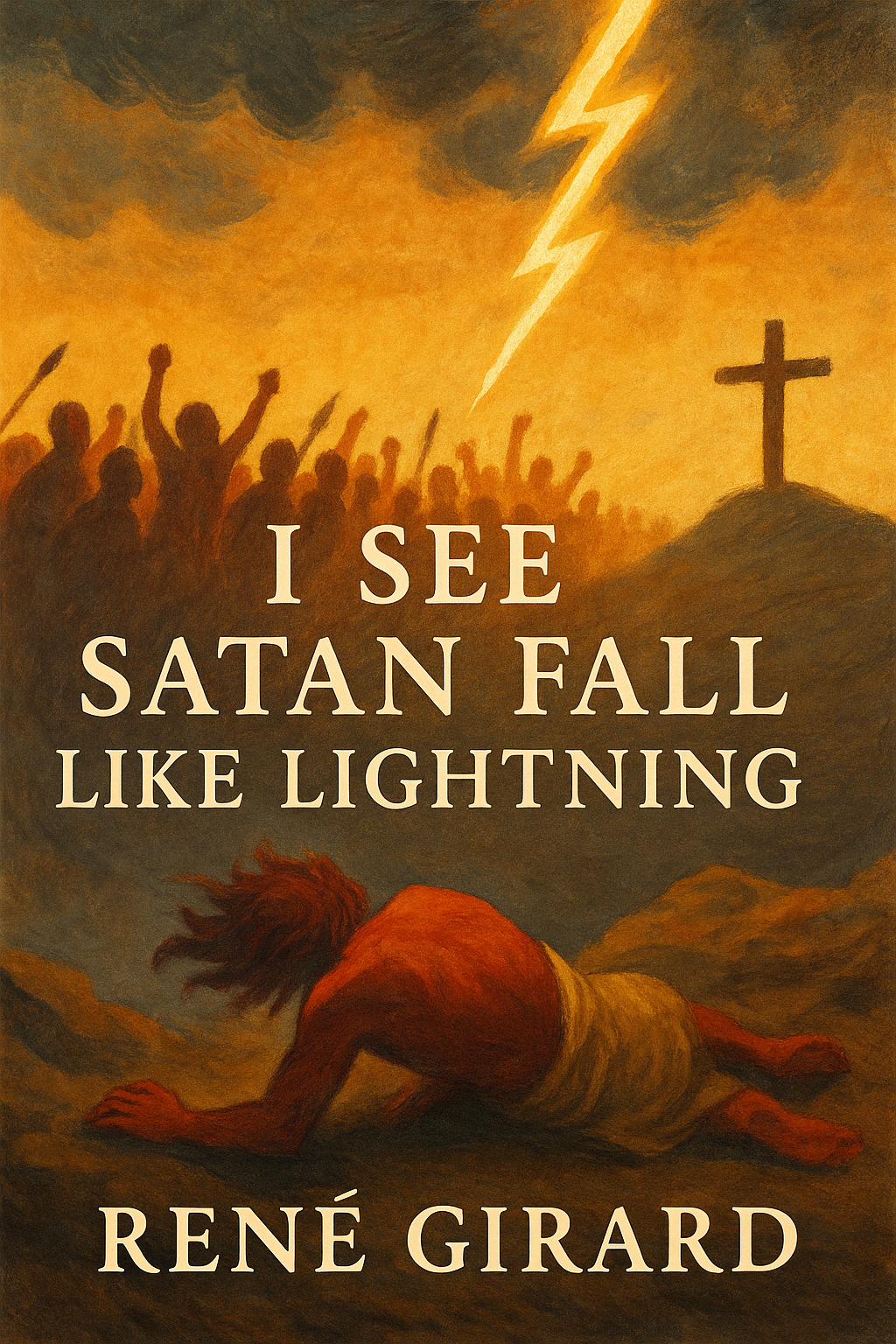
The singular claim in I See Satan Fall Like Lightning is that the Bible exposed the engine beneath myth. It doesn’t invent new sacred violence; it reveals the old pattern—and sides with the victim against it. The Crucifixion is not another sacrifice but the unmasking of sacrifice, showing that the victim was innocent, the crowd was wrong, and that what was once called sacred is just brutality in disguise.
In Part 2, we'll go deeper into Girard’s reading of Christianity as the first anti-myth. For now, Girard leaves us with a simple discipline: check the mob inside your own head before you sign the petition. Ask: Is this critique proportional—or is the tribe hungry for its next sacrifice?